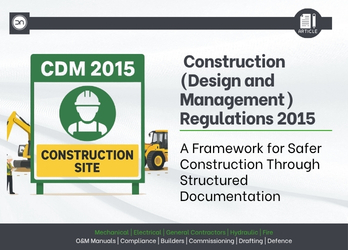
The Construction (Design and Management) Regulations 2015 (CDM Regulations) establish the legal framework for managing health, safety, and welfare across construction projects in the United Kingdom. While commonly interpreted as a safety regulation, CDM 2015 is more accurately understood as a risk and information management framework, requiring structured documentation to identify, control, and communicate risk throughout the asset lifecycle.
In modern construction, particularly on complex and multi-disciplinary projects, effective documentation is the mechanism through which CDM 2015 duties are discharged. From early design through to handover and occupation, the quality, accuracy, and accessibility of information directly influence both compliance and long-term building safety.
This aligns closely with international quality management principles set out in ISO 9001 and its regional adoptions, including BS EN ISO 9001.
Purpose and Core Principals
At its core, CDM requires that health and safety risks are systematically managed across the entire project lifecycle. This includes:
- Identifying hazards at the earliest possible stage
- Eliminating or reducing risks through design decisions
- Planning safe construction methodologies
- Communicating residual risks clearly to all stakeholders
- Ensuring information is retained for future use
Unlike traditional approaches that rely heavily on site-based controls, CDM 2015 places significant emphasis on front-end planning and design-stage risk management, supported by robust documentation.
Duty Holders and Information Responsibilities
CDM 2015 defines specific duty holders, each with legal responsibilities tied closely to documentation and information management through out the planning, design and construction phases of the project.
- The Client: responsible for ensuring that appropriate arrangements are in place for managing the project, including the provision of Pre-Construction Information (PCI) such as site surveys, existing asset information and hazard identification data. This information must be sufficient to allow designers and contractors to understand existing risks and constraints.
- The Principal Designer: holds a central role in coordinating health and safety during the design phase. This includes ensuring that designers identify hazards, eliminate risks where possible, and document any residual risks that need to be managed during construction or operation.
- The Principal Contractor: is responsible for planning, managing, and monitoring the construction phase. This is primarily achieved through the development and maintenance of the Construction Phase Plan (CPP) and supporting documentation such as Risk Assessments and Method Statements (RAMS) and Inspection Test Plans (ITPs).
- Designers and Sub Contractors: must contribute to the process by generating accurate, clear, and coordinated documentation that reflects the risks associated with their work.
Across all roles, the common thread is clear: if information is not properly documented, it cannot be effectively managed or communicated.
CDM 2015 Construction Documentation Requirements
As the project moves into construction, the Construction Phase Plan (CPP) sets out how risks will be managed on site. This is supported by detailed, task-specific documentation such as RAMS (Risk Assessments and Method Statements), permits to work, and quality control records. These documents collectively ensure that construction activities are carried out safely and in accordance with both design intent and regulatory requirements.
Inspection Test Plans (ITPs)
An Inspection and Test Plan (ITP) is a formal quality control document used to define, schedule, and record all inspections and tests required for a specific element of construction works. It establishes what is inspected, when, how, and by whom, ensuring compliance with project specifications, standards, and contractual obligations.
Commissioning is a structured quality assurance process that verifies building services systems are installed, tested, and operating in line with the design intent and the owner’s operational requirements. A Commissioning Plan defines the methodology, scope, responsibilities, testing procedures, and documentation requirements for this process. It typically applies to HVAC, domestic water systems, controls, lighting, fire protection systems, and energy management systems. The commissioning process ensures systems transition from installation to full operational functionality, meeting performance standards and regulatory expectations.
Activities usually begin during the design stage and continue through installation, equipment start-up, functional testing, and final handover.
O&M Manuals
Operation & Maintenance Manuals (O&M Manuals) are a comprehensive, technically authored documents, which provides building owners and operators with details of each item of mechanical and electrical equipment / plant enabling efficient operation, and effective maintenance for plant longevity, decommissioning, and final demolition of a building.
Building Handover Manuals (BHM)
Often referred to as an Architectural O&M Manual, a BHM is a structured, project-specific document issued at completion that captures what has been built and how it should be safely operated, maintained, and managed over its lifecycle. It typically consolidates as-built drawings, specifications, materials and finishes data, warranties, maintenance regimes, access strategies, and compliance records for the building fabric.
Under CDM 2015, the BHM provides information needed to identify residual risks, define safe maintenance procedures, and document access requirements for future works, particularly for high-risk elements such as roofs, façades, and fragile materials. This ensured that safety-critical information is accurate, accessible, and retained for the building’s lifecycle, reducing risk for future designers, contractors, and operators and helping duty holders meet their legal obligations.
Health and Safety File
The sole purpose of a H&S File is to provide essential health and safety data to personnel carrying out subsequent construction work, maintenance, cleaning, refurbishment, or demolition throughout the structure’s entire lifecycle. It is specifically designed to provide essential safety data to mitigate risks for future workers and building users.
This information must be clear, concise, and usable, not simply a collection of disconnected documents. Poorly structured or incomplete H&S Files create significant risks during maintenance, refurbishment, or demolition activities, where a lack of information can lead directly to unsafe conditions.
In practice, the H&S File overlaps significantly with BHM, O&M manuals, commissioning records, and asset data. When properly coordinated, these outputs form a coherent dataset that supports both compliance and operational efficiency.
Integration with Construction Documentation
Together, these documents form part of the “golden thread” of information, a concept reinforced under the Building Safety Act 2022. This golden thread ensures that accurate, up-to-date information is available throughout the building lifecycle, supporting both safety and regulatory compliance.
Why Documentation Quality is Critical Under CDM
Incomplete, inconsistent, or poorly structured information undermines the ability of duty holders to effectively identify, communicate, and manage risk throughout the design and construction process.
Where documentation is fragmented across multiple parties, systems, or formats, the result is often a lack of continuity between design intent, construction delivery, and operational requirements. This creates avoidable gaps in information that become increasingly difficult to resolve as the project progresses.
Common issues include:
- Fragmented or duplicated information across multiple documents and sources
- Lack of clarity or inconsistency around residual risks and design intent
- Missing or incomplete test certification and inspection records
- Poor coordination between design, construction, commissioning, and handover outputs
These challenges typically become most visible at practical completion and handover stages, where inconsistencies in documentation can delay certification, create compliance risks, and compromise the safe and efficient operation of the building.
A critical but often underappreciated factor in addressing these issues is the use of a single, coordinated source for construction documentation delivery.
Where documentation is managed by multiple disconnected parties or systems, the risk of inconsistency increases significantly. By contrast, using a single-source or integrated documentation provider creates a controlled and standardised information environment across the project lifecycle.
Key benefits of a single coordinated source for construction documentation delivery:
- Consistency of Information: All documentation is produced within a unified structure, reducing duplication and conflicting data across design, construction, and commissioning outputs.
- Improved Traceability: Changes, approvals, and revisions are managed within a single controlled framework, ensuring clear audit trails and version control.
- Seamless Integration: Information flows more effectively between design intent, site execution, commissioning activities, and final handover deliverables.
- Reduced Coordination Risk: Eliminates gaps and misalignment between multiple document producers, reducing the likelihood of missing or contradictory information.
- Faster Handover: Consolidated documentation enables more efficient collation of O&M manuals, commissioning records, and compliance evidence.
- Enhanced Compliance Confidence: A structured and unified dataset improves confidence in meeting CDM requirements and broader regulatory obligations.
In essence, a single-source documentation approach transforms documentation from a distributed administrative burden into a controlled project asset, ensuring alignment from initial design through to long-term operation.
Conclusion
CDM 2015 fundamentally reshaped how construction projects approach both safety and documentation. By placing information at the centre of risk management, CDM ensures that safety is not only designed and built into a project, but also preserved throughout its lifecycle.
For clients, contractors, and designers alike, the implication is clear: documentation is not a by-product of construction, it is a critical deliverable in its own right.
When properly implemented, CDM-driven documentation:
- Improves risk visibility and control
- Enhances coordination across project teams
- Supports efficient commissioning and handover
- Enables safer operation and long-term asset management
In an increasingly regulated environment, and with growing emphasis on the golden thread under the Building Safety Act 2022, the ability to deliver structured, accurate, and complete documentation is no longer optional: it is essential.
Outsourcing Technical Documentation
For contractors and project managers, technical authoring of Inspection Test Plan often presents a significant challenge due to time pressure, technical expertise and the need to focus on on-site duties. Outsourcing to specialist technical writing experts becomes invaluable in these situations to ensure that documentation is accurate, concise, delivered on time and cost effective.
Why Choose Dewick & Associates?
Dewick & Associates’ team are fully knowledgeable in the stringent requirements of local regulations and contractual requirements associated with construction documentation. By choosing to outsource to us, contractors achieve three key advantages:
- Technical Knowledge: our in-house Chartered Engineers (CIBSE CEng / CPEng. Mech MIEAust) and Technical Writing Team technically author all of our O&M Manuals. This professional expertise is crucial for accurately translating complex installation drawings / schematic / technical data into clear, concise and accurate documentation.
- Time & Cost Efficiency: freeing up expensive on-site management time.
- Guaranteed Compliance: delivering the complete, verified document necessary for timely Practical Completion and successful handover.
- Complete handover package: proactive document management and early-stage compilation throughout the project lifecycle, preventing last-minute information scrambles and reducing the risk of delays to Practical Completion.
We are able to transform complex, fragmented site data into an accessible, auditable, and high-quality documentation for your project handover.
Coupled with providing fully comprehensive construction documentation, including Building Handover Manuals, O&M Manuals, Health & Safety Files and Regulation 38 Files, CIBSE TM31 Logbooks complete the mandatory documentation provision at handover for your projects. Outsource this to the experts so you can concentrate on the pressing onsite works to complete the project to the high standard required.