Solar photovoltaic (PV) systems have rapidly become standard infrastructure across commercial, industrial, healthcare, education and residential developments. While often viewed simply as “solar panels”, a PV installation is a complex electrical system made up of multiple interconnected components, all of which require ongoing inspection and maintenance to ensure safety, reliability and performance.
Why Should Solar PV Systems Be Included in Asset Maintenance Programs?
Without structured maintenance, solar PV systems gradually lose performance while operational and safety risks increase. Reduced energy generation often occurs slowly and may go unnoticed, resulting in increased operating costs and reduced return on investment. As components deteriorate, the likelihood of premature equipment failure increases, particularly within inverters, electrical connections, isolation equipment, and battery systems. Environmental exposure can lead to water ingress, corrosion, and degradation of mounting systems and electrical infrastructure, while undetected electrical defects may develop into more serious issues including overheating, arc faults, and increased fire risk. Poor maintenance practices may also invalidate manufacturer warranties, reduce overall asset lifespan, and increase unplanned downtime. Perhaps most significantly, a poorly maintained solar system can continue operating for many years while silently under performing, leaving asset owners unaware of the true extent of lost generation and hidden defects.
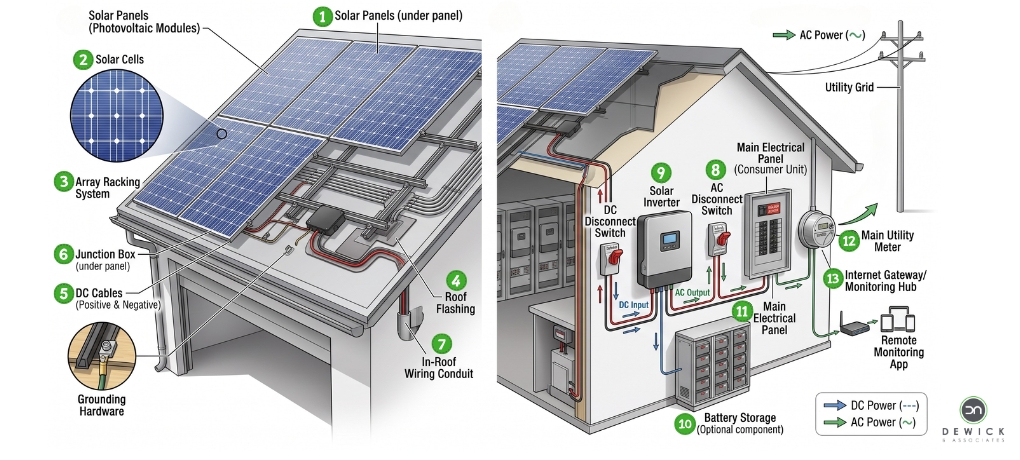
source: AI generated, royalty free
What assets form a Solar PV system?
Roof Mounted Solar Panels (PV Modules) : Solar photovoltaic (PV) modules (label 1) convert incoming solar radiation into Direct Current (DC) electrical energy through semiconductor photovoltaic cells (label 2), typically manufactured from monocrystalline or polycrystalline silicon. Individual modules consist of interconnected cells encapsulated within protective layers of tempered glass, polymer backing sheets, and aluminium framing designed to withstand long-term environmental exposure.
Solar Arrays and String Configuration: Individual modules are electrically interconnected to create strings and arrays that achieve the required operating voltage and power output of the system. Array configuration must consider voltage limits, cable sizing, current carrying capacity, temperature effects, shading profiles, and inverter operating ranges.
Mounting Systems and Roof Fixings (label 3): The mounting system provides structural support for the solar array and transfers loads safely into the building structure. Systems may be fixed directly to roof structures, ballasted, mechanically anchored, integrated into roofing systems, or ground mounted depending upon installation type. These systems must withstand significant dead loads, wind uplift forces, thermal expansion, snow loads (where applicable), and long-term environmental degradation. Mounting systems frequently include aluminium rails, stainless steel fixings, brackets, flashing systems (label 4), weatherproof penetrations, and bonding components.
DC Cabling, Connectors and Isolators: The DC cabling network (label 5) transports generated electricity from the solar array to inverter equipment. Unlike conventional building electrical systems operating primarily in Alternating Current (AC), solar arrays produce high-voltage DC electricity which presents unique hazards due to continuous current flow and increased arc flash risks. Cabling systems typically include UV resistant solar cable, junction boxes (label 6), cable trays, conduit systems (label 7), weatherproof connectors, and mechanical protection systems. Isolation devices (label 8) provide a safe method of disconnecting sections of the system during maintenance activities, emergencies, or fault conditions.
DC to AC Inverter (label 9): The inverter acts as the interface between the photovoltaic array and the building electrical system, converting DC electricity generated by solar modules into usable Alternating Current (AC) electricity suitable for building loads or export to the electricity grid / network. Modern inverters also perform numerous additional functions including Maximum Power Point Tracking (MPPT), system monitoring, fault detection, power quality control, anti-islanding protection, communications, and grid synchronisation.
Battery Energy Storage Systems (BESS) (label 10): Battery Energy Storage Systems provide the ability to store surplus generation for later use, increasing self-consumption and improving resilience during grid disturbances. Modern systems commonly utilise lithium-ion chemistry although alternative technologies continue to emerge.
AC Distribution Systems, Metering and Monitoring and Grid Connection: Following conversion to AC power, generated electricity enters building distribution infrastructure through switchboards (label 11) , distribution boards, protection devices, metering equipment (label 12, label 13), and or is exported to the utility network.
What are the Maintenance Requirements of a Solar PV System?
Despite common misconceptions, solar photovoltaic systems are not maintenance-free assets. While photovoltaic systems contain relatively few moving mechanical components compared with traditional building services infrastructure, they remain complex electrical systems exposed to harsh environmental conditions, thermal cycling, weathering, contamination, and continuous operational loading. Without structured preventative maintenance, system performance degradation and failure risk increases significantly over time.
Effective maintenance should be risk-based and asset-specific, considering system size, environmental conditions, criticality, manufacturer requirements, accessibility, and operational demands.
Monthly Maintenance
Monthly activities are primarily focused on identifying obvious defects and verifying the system is operating as expected, before significant performance losses occur, such as:
- Review monitoring platforms for abnormal performance, generation losses, alarms, or fault notifications
- Check inverter dashboards and communications systems are operational
- Perform visual inspections (where safely accessible) for obvious damage, contamination, shading, or vandalism
- Verify energy production remains broadly consistent with expected seasonal performance
- Inspect battery monitoring systems (where installed) for abnormal temperatures, charging behaviour, or fault conditions
Quarterly Maintenance
Quarterly maintenance introduces more structured inspections of system components and operational performance, to identify developing faults and prevent minor defects escalating into failures. Typical activities include:
- Inspect accessible modules for contamination, damage, cracks, hot spots, or physical deterioration
- Inspect cable routes, visible connectors, and support systems for deterioration or damage
- Inspect inverter condition including ventilation systems, cooling fans, and alarm histories
- Review mounting systems for loose components or signs of corrosion
- Verify monitoring systems, meters, and communications equipment remain operational
- Assess cleaning requirements depending on environmental conditions
Biannual Maintenance
Biannual maintenance typically includes more detailed inspections and targeted preventative maintenance activities, this maintains reliability, address degradation, and preserve system performance. Typical tasks include:
- Complete detailed inspection of arrays, mounting systems, roof interfaces, and penetrations
- Clean modules where contamination impacts generation performance
- Inspect DC isolators, junction boxes, combiner boxes, and accessible electrical equipment
- Verify battery systems, ventilation systems, and fire safety systems (where installed)
- Review performance trends and compare actual generation against expected outputs
- Inspect switchboards, distribution equipment, and protection devices
Annual Maintenance
Annual inspections are generally the most comprehensive maintenance activity and often form the basis of compliance, warranty, and asset management records. These verify system safety, maintain compliance, maximise lifespan, and protect asset value:
- Complete system inspection including modules, mounting systems, electrical infrastructure, batteries, and distribution equipment
- Electrical testing including insulation resistance, string testing, earth continuity, and protection verification
- Thermal imaging inspections of modules, connectors, switchboards, inverters, and electrical terminations
- Verification of earthing, bonding, surge protection, and lightning protection systems
- Detailed inverter inspection including firmware updates and functional testing
- Review maintenance records, defects, component replacements, and lifecycle planning
- Update asset registers and maintenance documentation
Ultimately, photovoltaic systems should be maintained similarly to any other critical building service asset: through planned preventative maintenance rather than reactive repairs.
What Legal & Regulatory Requirements are applicable to Solar PV Systems?
Solar PV systems are primarily governed through electrical safety legislation, installation standards, and grid connection requirements rather than standalone maintenance legislation. While regulations generally do not prescribe specific maintenance intervals, owners and operators remain responsible for ensuring systems continue operating safely throughout their lifecycle, key requirements include:
Australia / New Zealand
- AS/NZS 5033 (Installation And Safety Requirements For Photovoltaic (PV) Arrays), covering DC design, protection systems, wiring methods, isolation, testing, labelling, and fire safety requirements.
- AS/NZS 3000 (Wiring Rules) governing electrical installations, protection systems, earthing, testing, and ongoing electrical safety requirements.
- AS/NZS 4777 (Grid Connection Of Energy Systems Via Inverters) detailing grid-connected inverter requirements, protection systems, anti-islanding requirements, and network connection requirements.
- AS/NZS 5139 (Electrical Installations – Safety Of Battery Systems For Use With Power Conversion Equipment), applicable where battery storage systems are installed, introducing additional safety requirements relating to battery installation and protection systems.
United Kingdom
- BS 7671 (IET Wiring Regulations) specifically governs photovoltaic power supply systems, including isolation, protection, earthing, testing, and documentation requirements.
- IET Code of Practice for Grid-Connected Solar Photovoltaic Systems
- IEC 62446-1 (Photovoltaic (PV) systems – Requirements for Testing, Documentation and Maintenance) provides testing, inspection, commissioning, and documentation requirements for PV systems and is commonly adopted within industry practice.
- Electricity at Work Regulations 1989 requires electrical systems to be maintained to prevent danger, creating an ongoing obligation for inspection and maintenance.
- Health and Safety legislation including workplace duty-holder responsibilities requires building owners and operators to ensure systems remain safe throughout their operational life.
- Building Regulations Part P applies to electrical installation work associated with PV systems, requiring compliant installation and certification processes.
Canada
- Canadian Electrical Code (CEC), Part I (CSA C22.1) requires that electrical equipment must be installed and maintained so it does not present a hazard under normal operation and foreseeable fault conditions.
- Provincial Electrical Safety Legislation such as
- Technical Safety BC (British Columbia)
- Electrical Safety Authority (Ontario)
- Régie du bâtiment du Québec (Quebec)
Requiring electrical work to be performed by licensed contractors and ongoing obligation for installations to remain in a safe operating condition with owners remaining legally responsible for maintaining safe electrical installations.
Why Do Solar PV Systems Require Ongoing Maintenance?
Solar PV systems are now a critical component of modern building infrastructure, but their performance, safety, and longevity are entirely dependent on how they are managed over time. While the technology itself is highly reliable, it is not immune to environmental exposure, electrical degradation, or operational faults. A structured, risk-based maintenance approach ensures that issues are identified early, system performance is sustained, and compliance obligations are met across increasingly complex regulatory frameworks. Ultimately, effective maintenance is not simply about protecting energy generation, it is about safeguarding the broader building asset, reducing operational risk, and ensuring that solar PV systems continue to deliver safe, efficient, and predictable performance throughout their lifecycle.