Modern buildings are becoming increasingly sustainable, with higher standards for energy efficiency, reduced carbon emissions and improved environmental performance than ever before. Yet achieving these outcomes extends well beyond innovative design, efficient building systems and environmentally conscious materials.
The next challenge begins once construction is complete – maintaining the green building compliance.
Whether a project is targeting Green Star or NABERS in Australia and New Zealand, BREEAM in the United Kingdom, LEED across Canada and the United States, or similar sustainability initiatives in the Republic of Ireland, long-term success depends on a building continuing to perform as intended throughout its operational life.
This is where technical documentation plays a critical role in green building compliance.
While sustainability discussions often focus on design, construction methods and technology, comprehensive documentation ensures building owners and facilities managers have the information they need to operate, maintain and continually optimise building systems for years to come. Without it, even the most sustainable building can gradually lose efficiency, increase operating costs and struggle to demonstrate ongoing compliance with environmental performance frameworks.
Sustainability Doesn’t End at Practical Completion
Across the world, sustainability frameworks are increasingly moving beyond design intent and placing greater emphasis on measured operational performance.
Australia’s NABERS ratings assess how buildings actually perform in operation rather than how they were designed. Green Star encourages commissioning, building tuning and operational readiness. BREEAM recognises the importance of commissioning, handover and aftercare, while LEED places significant emphasis on ongoing documentation, operational policies and measured building performance.
Although each framework has its own assessment criteria, they all share a common objective: Sustainable buildings must continue performing efficiently throughout their lifecycle.
Achieving this depends on more than high-quality construction. It requires accurate, structured documentation that enables building operators to understand, maintain and continually improve building performance.
Closing the Performance Gap
Many buildings are designed to achieve ambitious sustainability targets but fail to operate at those same levels once occupied. This difference between expected and actual performance is commonly referred to as the performance gap.
There are many reasons this can occur:
- Building systems are not operated as intended
- Maintenance schedules are overlooked
- Equipment settings are altered without understanding their impact
- Future contractors lack access to accurate building information
- Building modifications are made using outdated documentation
Technical construction documentation helps minimise these risks by preserving the knowledge developed throughout design, construction and commissioning, ensuring it remains available long after the project team has left site.
O&M Manuals Help Protect Energy Performance
Operations and Maintenance (O&M) Manuals are often viewed simply as a contractual deliverable. In reality, they are one of the most valuable resources for maintaining a building’s environmental performance.
Well-structured O&M Manuals provide facilities teams with the information required to:
- Operate HVAC, electrical, hydraulic and fire systems efficiently
- Understand manufacturer operating parameters
- Follow preventative maintenance schedules
- Troubleshoot faults quickly
- Preserve equipment warranties
- Reduce unnecessary energy consumption
- Support long-term asset performance
When maintenance is undertaken correctly and systems continue operating as designed, buildings are far more likely to retain the energy efficiency and environmental outcomes they were originally intended to achieve.
Rather than sitting on a shelf after handover, an effective O&M Manual becomes an operational tool that supports the building throughout its lifecycle.
Commissioning Documentation Verifies Building Performance
Commissioning is the process of confirming that building systems perform in accordance with the design intent before practical completion.
However, the commissioning process is only as valuable as the documentation produced alongside it.
Comprehensive commissioning plans and records demonstrate that systems have been tested, adjusted and verified correctly. They also provide an invaluable reference for future recommissioning, seasonal tuning and ongoing optimisation.
Many sustainability frameworks specifically recognise commissioning as a key contributor to long-term building performance. Green Star promotes commissioning and building tuning, while LEED awards credits for enhanced commissioning and ongoing verification of building systems.
Without this information, future facilities teams lose critical knowledge about how systems were intended to operate, making optimisation significantly more difficult.
As-Installed Drawings Support Future Sustainability Upgrades
Buildings rarely remain unchanged throughout their operational life. As organisations pursue decarbonisation strategies, many facilities undergo upgrades including:
- Heat pump installations
- Solar photovoltaic systems
- Battery storage
- EV charging infrastructure
- Smart building technologies
- HVAC replacements
- Building automation upgrades
Accurate as-installed drawings provide the foundation for these future improvements. Without reliable records, project teams often spend unnecessary time investigating existing installations before new work can begin. This increases costs, delays projects and introduces additional risk.
Well-maintained documentation enables future upgrades to be designed and delivered more efficiently while supporting the ongoing evolution of sustainable buildings.
Documentation Supports Facilities Management
Once construction is complete, responsibility for building performance shifts to facilities managers and asset owners. Their ability to maintain sustainability outcomes depends heavily on the quality of information handed over at project completion. Good documentation helps facilities teams:
- Understand complex building systems
- Implement preventative maintenance
- Manage replacement assets
- Train new personnel
- Monitor operational performance
- Investigate faults
- Demonstrate compliance during audits
Rather than recreating knowledge every time personnel change, structured documentation preserves it for the entire life of the building.
Sustainability Frameworks Around the World Share a Common Foundation
Across Australia, New Zealand, the United Kingdom, the Republic of Ireland, Canada and the United States, sustainability frameworks differ in terminology, assessment methods and certification requirements. However, they all share one common expectation: building performance must be maintained long after construction is complete.
The comparison below highlights how technical documentation underpins many of the operational requirements that support these internationally recognised sustainability frameworks.
| Region | Framework | Primary Sustainability Focus | Documentation That Supports Compliance |
| 🇦🇺 Australia | Green Star | Sustainable design, commissioning and operational performance | O&M Manuals, Commissioning Plans, Building Tuning Plans, Asset Registers |
| 🇦🇺 Australia | NABERS | Measured operational energy and water performance | O&M Manuals, Maintenance Records, Asset Registers |
| 🇳🇿 New Zealand | Green Star NZ | Sustainable design and lifecycle performance | O&M Manuals, Commissioning Documentation, Building Handover Manuals |
| 🇬🇧 United Kingdom | BREEAM | Whole-of-life building performance | O&M Manuals, Building User Guides, Commissioning Records, Health & Safety Files |
| 🇮🇪 Republic of Ireland | BREEAM / BER | Operational efficiency and energy performance | O&M Manuals, Building Logbooks, Commissioning Documentation |
| 🇨🇦 Canada | LEED / Zero Carbon Building Standard | Energy efficiency and operational performance | O&M Manuals, Commissioning Reports, As-Installed Drawings |
| 🇺🇸 United States | LEED | Ongoing building performance and facilities management | O&M Manuals, Commissioning Plans, Asset Registers |
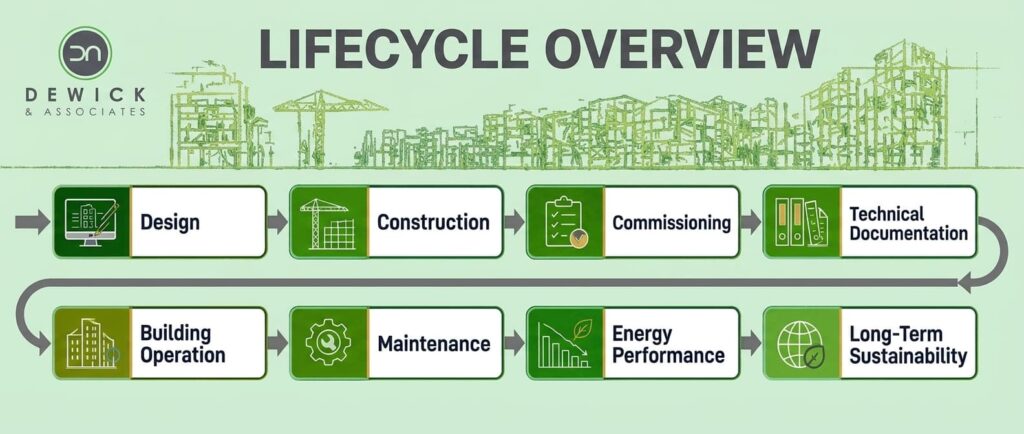
Technical Documentation Supports Every Stage of a Building’s Lifecycle
While sustainability frameworks use different terminology and assessment methods, they all rely on accurate information being available throughout the life of the building. Documentation doesn’t simply support handover. It supports every stage of ownership, operation and future adaptation.
Documentation Is Part of the Sustainability Journey
Sustainability is no longer measured solely by the performance of a building on the day it is handed over. Increasingly, it is judged by how effectively that building continues to operate over the years that follow.
Technical documentation provides the knowledge that allows facilities managers, contractors and owners to preserve energy efficiency, maintain complex building systems and support future upgrades throughout the building lifecycle.
At Dewick & Associates, we believe technical documentation is more than a contractual requirement. It is a vital part of creating buildings that continue to perform safely, efficiently and sustainably throughout their operational life. By working closely with builders, contractors and asset owners, we help ensure critical building information is captured, verified and delivered in a way that supports facilities management, future upgrades and ongoing environmental performance. Through accurate, structured documentation and a commitment to quality at every stage of the project, we aim to be a trusted partner in helping our clients achieve lasting sustainability outcomes, not just at handover, but throughout the entire lifecycle of their buildings.
From O&M Manuals and Commissioning Plans to Building Handover Manuals, Building Tuning Plans, Asset Registers and As-Installed Drawings, our work helps ensure valuable project knowledge is captured, organised and available when it is needed most.
Ultimately, good documentation doesn’t just support compliance. It supports better-performing, more sustainable buildings.