The UK Construction Product Compliance regulatory framework is undergoing significant reform.
Following the publication of the Construction Products Reform White Paper in February 2026, the Government is progressing proposals strengthen construction product safety, accountability, testing, certification, product information and enforcement. A separate consultation has also proposed introducing a General Safety Requirement for currently unregulated construction products.
For construction projects, the implications of these changes extend beyond the products themselves. As expectations around product safety, compliance, accountability and traceability increase, so does the importance of being able to demonstrate what products were specified, what was supplied, where they were installed and what evidence supports their compliance.
For project teams, this means construction product information cannot simply be treated as something to collect at the end of a project. It needs to be collated, checked and managed throughout construction.
The proposed reforms place greater emphasis on accurate product information, traceability and record retention, making the way project teams capture and manage product information increasingly important.
Why is Construction Product Regulation Changing?
The UK’s construction products regulatory framework is being strengthened following concerns about gaps in regulation, product safety and accountability. The Government’s Construction Products Reform White Paper, published in February 2026, represents a significant stage in this reform programme. It proposes a more comprehensive regulatory framework covering areas including product requirements, testing and certification, product information and enforcement.
A separate consultation has also proposed a General Safety Requirement for currently unregulated construction products. The proposal would introduce a requirement for construction products placed on the market to be safe, alongside additional responsibilities and enforcement powers.
These wider reforms are not all legislation yet. The consultations ran from February to May 2026, with the Government continuing to consider responses and develop the proposed regulatory framework. However, the direction of travel is clear: greater accountability, stronger oversight and better information about construction products.
What has Already changed?
It is important to distinguish between regulatory changes that are already in force and the wider reforms still being developed.
The Construction Products (Amendment) Regulations 2025 came into force on 8 January 2026. Among other provisions, these regulations enable the continued recognition in Great Britain of certain construction products meeting relevant EU requirements and carrying CE marking, including products covered by the EU Construction Products Regulation 2024.
This is separate from the Government’s wider programme of construction product reform.
For project teams, this creates a regulatory environment that is continuing to evolve. Product compliance requirements, marking arrangements and information requirements need to be considered in the context of the specific product, project and legislation that applies.
What Does Construction Product Compliance Mean for Projects?
The impact of stronger construction product regulation is likely to be felt across the project supply chain. Manufacturers, suppliers, importers, contractors and other organisations involved in placing or using construction products may have different responsibilities depending on the product and applicable regulatory requirements.
For project teams, however, one practical question remains consistent:
Can you demonstrate that the products incorporated into the building are the products that were specified, appropriately assessed and supported by the required information?
That can involve much more than a product datasheet.
Depending on the product and project, relevant construction product information may include:
- Product data and technical specifications
- Declarations of Performance or other declarations of conformity
- CE or UKCA marking information where applicable
- Test reports and certification
- Manufacturer information
- Installation requirements
- Fire performance information
- Product identification and traceability information
- Batch or serial information where relevant
- Evidence relating to substitutions
- Installation records
- Inspection and testing records
- Maintenance and operational requirements
The exact requirements will vary according to the product and applicable legislation. The important point is that the evidence supporting compliance needs to be available, accurate and traceable when it is required.
Product Compliance Doesn’t End When the Product Arrives On Site
A product may have appropriate certification or compliance information when it is supplied, but that information still needs to be connected to the actual project. This is where construction documentation becomes particularly important. Projects frequently involve substitutions, alternative manufacturers, revised specifications or products selected by specialist subcontractors. If these changes are not properly recorded, there can be a disconnect between the information originally specified and what was ultimately supplied and installed.
A robust documentation process should therefore establish a clear link between:
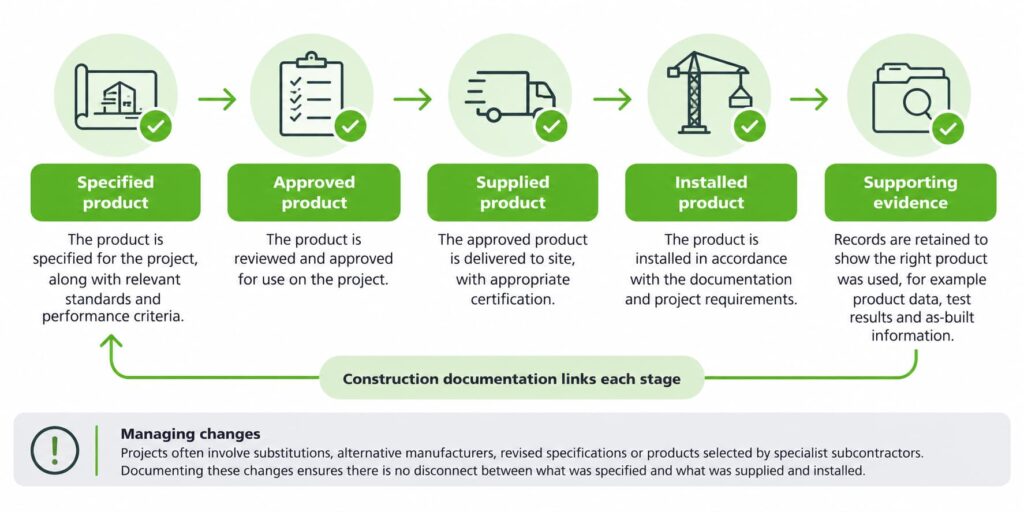
This does not mean the documentation team is responsible for determining whether a construction product is legally compliant. It means the evidence supporting the project’s compliance needs to be captured, coordinated and retained appropriately.
Why Does Construction Product Information Matter at Handover?
Handover is often where weaknesses in a project’s information management become apparent. By this stage, project teams may be trying to gather information from numerous manufacturers, subcontractors and suppliers, sometimes months after products were delivered and installed. Missing certificates, incomplete product information, unidentified substitutions or documents that cannot be clearly associated with installed equipment can make the final handover process unnecessarily difficult.
A well-managed handover process instead develops this information progressively.
Construction product information can be incorporated into the project’s documentation as construction progresses, allowing missing information or inconsistencies to be identified before practical completion.
This is particularly important for building systems and products that require ongoing inspection, testing, servicing or maintenance.
The objective is not simply to produce larger O&M Manuals or Building Handover Manuals, it is to provide reliable project information that can be understood, traced and used throughout the building’s operational life.
The Role of O&M Manuals and Building Handover Manuals (BHM)
O&M Manuals / BHMs provide an important repository for information about products and installed systems. Depending on the project, this may include:
- Manufacturer and supplier information
- Product technical data
- Certificates and declarations
- Installation information
- Testing and commissioning records
- Maintenance requirements
- Warranties
- Replacement information
- As-installed equipment schedules
- Asset identification
The value comes from how this information is structured and coordinated, rather than simply how much information is included. A collection of disconnected manufacturer PDFs does not necessarily provide a useful record of what was actually installed.
A properly coordinated O&M Manual / BHM should help the building owner and facilities team understand what is installed, where it is installed, how it operates, how it should be maintained and what supporting documentation is available.
What About the Health & Safety File and Regulation 38 Documentation?
Construction product information can also form part of wider statutory and handover documentation. For projects subject to CDM 2015, the Health & Safety File needs to contain information that will help those carrying out future construction work understand the building and the risks associated with it.
Similarly, Regulation 38 information is intended to provide relevant fire safety information to the responsible person when building work is completed.
These documents have different purposes and should not be treated as interchangeable with O&M Manuals or Building Handover Manuals.
However, information relating to products, systems, installation and performance may need to be considered across the project’s wider information requirements. This reinforces the importance of a coordinated approach to documentation rather than treating each handover document as an isolated exercise.
How Can Project Teams Prepare for Construction Product Compliance?
The wider construction product reforms are still developing, but project teams do not need to wait for every element of the new regime to become legislation before reviewing and strengthening their processes.
The direction of regulatory change is towards greater product safety, accountability, transparency and traceability. For project teams, this makes it increasingly important to have a clear and consistent process for identifying, collating, checking, coordinating and retaining construction product information throughout the project.
A practical starting point is to review how product information is managed from specification and procurement through to installation and handover:
- Identify critical product information early: Establish which products and systems require specific certification, declarations, testing or other evidence.
- Assign responsibility: Make sure it is clear who is responsible for obtaining, checking and submitting product information at each stage of the project.
- Capture information progressively: Build product information into the project documentation process as construction progresses, rather than relying on a final document collection exercise immediately before handover.
- Record substitutions: Maintain a clear process for recording changes where products differ from the original specification or approved selection.
- Link information to installed assets: Where appropriate, establish a clear connection between product information, the installed product, system or location and the supporting documentation.
- Check completeness before handover: Review the information progressively and identify missing certificates, declarations, test information and manufacturer documentation while there is still time to resolve them.
- Maintain a clear audit trail: Ensure the final project record provides a reliable history of the products and systems incorporated into the building and the supporting evidence retained.
The full impact of the UK’s construction product reforms will become clearer as the Government develops the proposals into legislation. However, contractors, developers and project managers do not need to wait for those changes to take effect before strengthening their project processes.
A structured process for managing construction product information can help ensure that the right information is captured at the right time, checked appropriately and available when it is needed, particularly at handover.
How can Dewick & Associates Assist?
Dewick & Associates supports construction teams with the technical authoring, coordination and collation of project information required for construction and handover. This includes O&M Manuals, Building Handover Manuals, Health & Safety Files and Regulation 38 documentation.
Our role is not to determine whether a construction product is legally compliant. Instead, we help project teams collate, structure and coordinate the information and supporting documentation generated throughout the project, so that the final handover provides a clear and usable record of the completed building.
As construction product regulation continues to evolve, having the right information is becoming increasingly important. Good compliance starts with the right evidence. Good handover makes that evidence accessible.