World Quality Week 2026 | 9–13 November 2026
Quality is often thought of as the final review before a project is handed over. In reality, it begins much earlier.
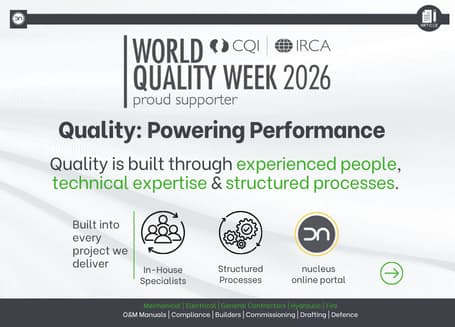
This year’s World Quality Week theme, Quality: Powering Performance, recognises that quality is created through the way organisations work every day. At Dewick & Associates, that principle is reflected in every stage of the construction documentation process, from project coordination and technical authoring through to engineering review and final delivery.
As Construction Documentation Specialists working across Australia, New Zealand, the UK, Ireland and Canada, we believe high-quality documentation is achieved through the right combination of experienced people, structured processes and continual improvement.
Quality Starts with People
Construction documentation is about far more than compiling information. Construction documentation requires more than the ability to compile information. It requires an understanding of how buildings are designed, constructed, commissioned, operated and maintained. It also requires the ability to recognise when information is incomplete, identify inconsistencies, ask the right questions and communicate technical details clearly.
Our in-house team of Client Coordinators, Technical Writers, Engineers, Technical Officers and Drafters each contribute specialist knowledge throughout the documentation process. Working collaboratively allows us to identify missing information, resolve inconsistencies and produce documentation that is accurate, practical and easy to use.
Our team’s varied experience helps us approach projects from different angles. Construction and builder backgrounds bring practical insight into site activities, subcontractor deliverables and the realities of project handover. Technical Writers turn complex information into structured, usable documents. Client Coordinators keep communication moving, manage outstanding information and help resolve issues before they become bigger problems. Drafters support the accurate presentation of technical information, while our engineers bring specialist knowledge and professional judgement to the work.
Quality is a collective responsibility. It is strengthened when each person understands their contribution and how it affects the final outcome.
Technical Expertise Supports Better Outcomes
Construction documentation plays an important role in the ongoing operation of a building. Equipment schedules, commissioning records, operating procedures and maintenance requirements all need to work together to provide a complete picture of the installed systems.
Our in-house engineering expertise, supported by Chartered Professional Engineers and appropriately qualified and registered engineering professionals, provides technical depth across relevant building services and compliance work. Professional qualifications and registrations, including CPEng, MIEAust, CEng, RPEQ and applicable state registrations, reflect the specialist knowledge available within our team.
Working alongside our Technical Writers and Client Coordinators, our engineers help ensure documentation is technically accurate, coordinated and suitable for the project’s requirements.
This multidisciplinary approach allows us to combine engineering knowledge with clear technical communication, creating documentation that supports building owners, facility managers and maintenance teams long after construction is complete.
Continuous Improvement: Learning, Refining and Evolving
At Dewick & Associates, continuous improvement is an important part of how we approach quality. Every project provides an opportunity to learn, whether that comes from successful outcomes, challenges encountered during delivery, client feedback or reviewing the effectiveness of our own processes.
Construction projects continue to become more complex, with evolving technologies, changing requirements and increasing expectations around the quality, accessibility and usability of project information. To support our clients effectively, we need to continually review the way we work and identify opportunities to improve consistency, efficiency and outcomes.
This may involve refining document structures, improving information requirements, strengthening review processes, enhancing internal workflows or finding better ways to communicate project requirements and outstanding actions. Small improvements made throughout the process can have a significant impact on the quality of the final deliverable.
Our multidisciplinary team plays an important role in this approach. By bringing together Client Coordinators, Technical Writers, Engineers, Technical Officers and Drafters, we are able to share knowledge across different areas of expertise and gain different perspectives on how documentation can be improved.
Lessons learned from completed projects, recurring information gaps and feedback from project teams help us identify where changes can make a difference. Rather than relying on knowledge held by individuals, we aim to build a culture where experience is shared and improvements are embedded into the way we work.
Continuous improvement also means challenging existing processes and asking whether there is a better way to achieve the desired outcome. A process that has worked well in the past may not always be the best approach as projects, technology and client expectations evolve.
This mindset extends to the systems we use, including nucleus, our bespoke documentation portal. By reviewing how information is collected, tracked and managed, we continue to refine the way technology supports collaboration, visibility and document control across projects.
Ultimately, continuous improvement is about creating a stronger, more consistent approach to quality. It allows us to respond to changing project environments, strengthen the reliability of our documentation and continue delivering information that supports successful handover and long-term building performance.
Quality is not achieved through one review, one process or one person. It is strengthened through ongoing learning, collaboration and the commitment to continually do things better.
Structured Processes, Supported by Technology
Quality also depends on having consistent processes.
Our bespoke online portal, nucleus, was developed in response to the challenges of managing construction documentation across complex projects, including fragmented communication, missing information, multiple subcontractors and limited visibility of progress. nucleus provides a central location for document collection, project tracking, outstanding actions and collaboration. Rather than relying on disconnected emails and spreadsheets, project teams have greater visibility of documentation progress throughout construction.
nucleus supports quality in several ways.
Visibility: Project teams can see the status of documentation and identify information that remains outstanding.
Traceability: A structured workflow supports document tracking and helps maintain control over project information and review stages.
Coordination: Client Coordinators can monitor requirements, follow up on gaps and keep information moving through the process.
Consistency: Defined workflows support a repeatable approach across projects while allowing for different client requirements and project-specific needs.
Accessibility: Centralised project information makes it easier for relevant users to access documentation and understand where a project stands.
Technology, however, is only part of the solution. While nucleus improves coordination, traceability and consistency, it works alongside the experience and judgement of our people. A portal cannot replace engineering judgement, the ability to interpret complex technical information or the experience needed to recognise when something is wrong.
Quality comes from combining structured workflows with technical expertise and effective communication.
Looking Beyond Compliance
Meeting contractual and compliance requirements is essential, but quality documentation should achieve more than simply ticking a box.
A document may satisfy a contractual requirement and still be difficult to navigate. A manual may contain manufacturer information but fail to explain the installed system clearly. A handover package may contain numerous files without providing a coherent picture of the building and its assets.
For D&A, useful documentation must bring together accuracy, completeness, clarity, accessibility and practical application.
This means considering the people who will use the information after construction: facility managers, maintenance contractors, building operators, asset owners and others responsible for the building throughout its life.
Can they locate the information they need? Does it reflect the equipment actually installed? Are operating and maintenance requirements clear? Are commissioning records and relevant certificates included? Can the information support safe operation, planned maintenance and future asset management?
These questions help D&A look beyond document production to the purpose of the information itself.
Ultimately, the quality of construction documentation should be measured by how effectively it supports the people who rely on it after handover.
Quality is Built into Everything We Do
At Dewick & Associates, quality is not a final review or a single stage in the documentation process. It is built into the way our people collaborate, the expertise they bring, the systems we have developed and our commitment to continual improvement.
As our business continues to evolve, so does our responsibility to review our methods, learn from experience and find better ways to support our clients and their projects.
World Quality Week provides an opportunity to reflect on that commitment. For us, Quality: Powering Performance is more than a theme. It reflects our ongoing focus on delivering coordinated, technically accurate construction documentation that supports successful project handovers and the long-term performance of the buildings our clients deliver.