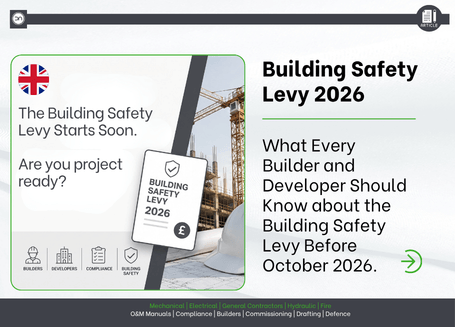
The Building Safety Levy comes into effect in England on 1 October 2026 and will apply to certain residential developments and purpose-built student accommodation (PBSA). The Levy is calculated primarily on a per-square-metre basis, with rates varying by local authority area and exemptions applying to certain developments.
For developers, contractors and project teams, understanding whether a project is affected and ensuring the information required to assess the Levy is accurate and available should form part of project planning ahead of October 2026.
Building Safety Levy 2026: At a Glance
| Effective from: | 1 October 2026 |
| Applies in: | England |
| Mainly applies to: | Qualifying residential development and certain PBSA. |
| Calculation: | Primarily based on chargeable floorspace |
| Rates: | Vary by local authority |
| Brownfield development: | Qualifying previously developed land receives a 50% discounted rate |
| Exemptions: | Certain developments and housing types are exempt |
| Who should review it? | Developers, contractors and residential project teams |
What is the Building Safety Levy?
The Building Safety Levy is a charge on certain residential developments in England. It is being introduced to raise funds towards the remediation of building safety defects.
The Levy will apply to qualifying building control applications and notices submitted from 1 October 2026. It applies to developments creating new dwellings and, in relevant circumstances, new bedspaces in purpose-built student accommodation (PBSA), as well as certain changes of use to residential purposes.
The Levy is generally calculated on a per-square-metre basis, using the applicable rate for the local authority area and the chargeable residential floorspace.
Rates vary between local authority areas, reflecting differences in local housing development economics. A 50% discounted rate applies to qualifying development on previously developed land, commonly referred to as brownfield land. This means that the potential financial impact of the Levy will vary considerably between projects.
When does the Levy apply?
The Levy comes into operation on 1 October 2026.
One of the key considerations for developers is therefore the timing of the building control application.
Applications for building control approval relating to the provision of dwellings or PBSA bedspaces submitted on or after 1 October 2026 will be subject to the Levy rules, unless an exemption applies.
Applications submitted before 1 October 2026 are not subsequently brought into the Levy simply because they are varied after the commencement date, although there are specific circumstances that can affect how the rules apply. For example, a pre-October application that is rejected and subsequently resubmitted after 1 October 2026 may become liable.
For projects currently moving through design and approval, the October 2026 implementation date should therefore form part of project planning discussions.
Which Developments are affected?
The Levy is aimed primarily at residential development, but not every residential project will necessarily result in a payment.
A project will generally attract the Levy if it meets three statutory criteria:
- Scale Threshold: It creates > 10 new dwellings or ≥ 30 bedspaces in Purpose-Built Student Accommodation (PBSA).
- Floorspace Creation: It generates net new residential Gross Internal Area (GIA), including change-of-use or vertical extension projects.
- Non-Exempt Client: The client/developer is not an exempt non-profit entity such as certain affordable, social housing; certain types of communal or specialist accommodation.
It is therefore important not to assume that a project is either automatically liable or automatically exempt. The relevant project characteristics need to be considered against the regulations and current Government guidance.
What information is required for the Building Safety Levy?
One of the important aspects of the Building Safety Levy is that information needs to be provided through the building control process.
When an application for building control approval is submitted for works involving new dwellings or PBSA bedspaces, the project must be considered against the Levy charging conditions.
Where a development is potentially chargeable, the relevant information must be provided so that the collecting authority can determine the Levy.
Even where a development is not expected to attract a charge, information may still be required to allow the collecting authority to verify that the development is exempt or otherwise outside the charging conditions.
This reinforces an increasingly important principle across the construction industry: Good project information is not simply a handover requirement. It supports compliance throughout the project lifecycle.
Why should project teams be thinking about this now?
For developers and contractors, the introduction of the Levy adds another consideration to an already complex approval and construction process.
Projects commencing or progressing around the October 2026 implementation date should consider:
- Project timing: Where is the project currently sitting within the design, planning and building control process? Does the timing of the application fall before or after the Levy commencement date?
- Development scope: How many dwellings or PBSA bedspaces are being created? Does the wider development or planning permission affect how the project is assessed?
- Floorspace information: Is the information required to establish the relevant chargeable floorspace available and properly coordinated?
- Exemptions: Does the development qualify for an exemption, and is the supporting information available to demonstrate this?
- Changes during design and construction: Have changes to the development affected the information originally provided? Are drawings, schedules and other project records being updated consistently?
- Responsibility: Is it clear who within the project team is responsible for collating, checking and submitting the required information?
These are relatively straightforward questions, but they become more difficult to answer when project information is fragmented across multiple consultants, contractors, subcontractors and document systems. The wider importance of coordinated project information: The Building Safety Levy is one example of the increasing importance placed on reliable project information.
Throughout a construction project, information is generated by multiple parties and at different stages. Drawings are revised, equipment schedules change, specifications are updated, systems are commissioned and additional records are produced as the building progresses.
Without a coordinated approach, it can become difficult to establish which information is current, which documents have been superseded and whether the final project record accurately reflects what has actually been constructed.
For building safety and regulatory compliance, this can create unnecessary risk.
For project teams, the objective should therefore be more than simply collecting documents at the end of the project.
Information should be developed, coordinated and checked progressively throughout design, construction, commissioning and handover.
From Construction Information to Building Handover
The same principle applies to the information required at practical completion and handover. Building owners and operators need reliable information about the building and its systems to support safe and effective operation. This can include:
- Operation & Maintenance Manuals (O&M Manuals)
- As-built and as-fitted drawings
- Asset Registers
- Commissioning Plans
- Testing and Inspection Plans
- Certificates and compliance documentation
- Preventative Maintenance Log Sheets and requirements
- Manufacturer information
- Building User Guides
- Health & Safety Files (H&S Files)
- Regulation 38 Fire Information Files
The quality of this information depends heavily on how it is managed during the project.
Waiting until the end of construction to identify missing information, resolve inconsistencies or establish what has actually been installed can result in unnecessary delays and additional work.
A progressive approach provides greater visibility of outstanding information and allows issues to be addressed while the relevant project teams and subcontractors are still engaged.
What should Developers and Contractors do now?
With the Levy commencing in October 2026, residential project teams should consider reviewing projects currently in the pipeline and identifying those that may be affected.
A practical review could include:
- Identify potentially affected projects: Review residential and PBSA developments currently in planning, design, procurement and construction.
- Review the building control position: Establish whether relevant applications or notices are likely to fall before or after 1 October 2026.
- Confirm project information: Ensure that key information relating to dwellings, bedspaces, floorspace and development scope is available and coordinated.
- Check potential exemptions: Determine whether the project may qualify for an exemption and identify what evidence may be required.
- Establish responsibility: Make sure there is a clear owner within the project team for coordinating Levy-related information.
- Maintain information progressively: Avoid relying on a final-stage information collection exercise. Keep project records updated as the design and construction develop.
- Consider the wider handover requirement: Use the opportunity to review how construction, commissioning and handover information is being captured and managed.
Building Safety Levy and Construction Documentation
The introduction of the Building Safety Levy highlights a broader structural shift across the UK construction sector: regulatory compliance requires verifiable, dynamic project information from day one.
Just as inaccurate GIA data can derail a Levy assessment, fragmented handover records create severe compliance and completion risks. Residential developments generate vast quantities of technical data across design, construction, and commissioning—from drawings and specifications to test certificates and asset schedules. Treating this documentation as an end-of-project collection exercise frequently leads to missing information, delayed Gateway 3 sign-offs, and blocked handovers.
Managing handover documentation progressively throughout the construction lifecycle gives project teams control over regulatory requirements. Maintaining accurate, up-to-date records ensures that asset registers, commissioning plans, and safety dossiers fully reflect built reality long before practical completion.
How Dewick & Associates supports project delivery
At Dewick & Associates, we assist developers, main contractors, and MEP teams in managing this compliance burden. We provide outsourced technical authoring, coordination, and collation of construction and handover documentation throughout the project lifecycle.
From Operation & Maintenance (O&M) Manuals and Building Handover Manuals to Commissioning Plans and Regulation 38 Fire Information Files, our engineer-led approach focuses on developing information progressively. By converting fragmented site data into an audit-ready project record, we help project teams reduce compliance risks, protect completion timelines, and deliver seamless asset handovers.
Technical expertise. Construction knowledge. Reliable project information.
This article provides general information only and should not be relied upon as legal or regulatory advice. Project teams should refer to the current Building Safety Levy Regulations and Government guidance when assessing individual projects.