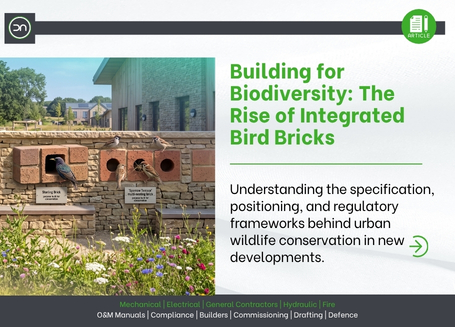
As urban development continues to replace natural nesting habitats, many bird species are finding it increasingly difficult to establish breeding sites within towns and cities. Species that have historically nested within buildings, such as swifts, house sparrows and starlings, have experienced significant population declines across many parts of the world as modern construction methods eliminate the gaps, cavities and roof spaces they once relied upon.
Bird bricks provide a practical solution by incorporating purpose-built nesting cavities directly into the building fabric. While often viewed as a relatively small design feature, bird bricks can play an important role in supporting biodiversity, meeting planning requirements and contributing to broader environmental objectives.
As governments, planners and developers place increasing emphasis on biodiversity outcomes, bird bricks are becoming a more common feature within residential, commercial, education and public infrastructure projects.
What Are Bird Bricks?
Bird bricks are integrated nesting units designed to be installed within external masonry walls. They are manufactured to resemble a standard brick or block while containing an internal cavity suitable for nesting birds.
Common types include:
- Swift bricks
- House sparrow terraces
- Starling nesting bricks
- General-purpose nesting cavities
- Integrated bird and bat habitat systems
Unlike external nest boxes, bird bricks form a permanent part of the building structure, providing a durable and low-maintenance habitat solution with a design life equivalent to the building itself.
Why Are Bird Bricks Important?
Historically, many bird species, such as swifts / swallows, nested within gaps in roof structures, wall cavities and building facades. Modern construction standards have significantly improved weatherproofing, thermal performance and building envelope integrity, but these improvements have also removed many traditional nesting opportunities. Bird bricks help compensate for this habitat loss by providing safe, purpose-designed nesting locations within new developments.
This aids bird populations which contribute to healthy urban ecosystems through:
- Natural pest control
- Pollination and seed dispersal
- Increased ecological resilience
- Improved biodiversity outcomes within developed environments
Integrating nesting habitats into buildings allows developments to contribute positively to local ecological networks without requiring significant additional land or infrastructure.
Many developers now recognise biodiversity enhancement as a key component of sustainable construction. Bird bricks provide a visible and measurable environmental initiative that can support planning approvals, sustainability targets and corporate environmental commitments.
Legislative and Regulatory Requirements
England
Bird bricks and swift bricks are not currently mandated under the Building Regulations for England. However, they are increasingly secured through planning conditions, biodiversity enhancement requirements and ecological assessments associated with new developments.
Several local authorities have introduced policies or supplementary guidance that encourage or effectively require integrated nesting features to support declining cavity-nesting species. Brighton & Hove City Council is one of the most established examples, with Supplementary Planning Document SPD11 setting minimum requirements for swift bricks on residential and commercial developments. Similar approaches have been adopted by Greater Cambridge Shared Planning, Exeter City Council, Tower Hamlets, Cornwall Council, Bristol City Council, Oxford City Council, Bath and North East Somerset Council and West Berkshire Council, with biodiversity enhancements becoming increasingly common across London and the South East.
A key distinction is that England’s mandatory Biodiversity Net Gain (BNG) framework focuses on habitat creation and measurable biodiversity units rather than species-specific measures. Consequently, bird bricks are generally secured through planning conditions, ecological assessments and sustainability frameworks rather than BNG calculations themselves.
As a result, developers and contractors face an increasingly fragmented network of local authority requirements and sustainability expectations, making early coordination and documentation essential to ensure biodiversity commitments are delivered.
Scotland / National Planning Framework 4 (NPF4)
Scotland has become the first UK nation to introduce specific legislative requirements for integrated nesting features within new buildings. In 2026, the Scottish Parliament approved legislation requiring the installation of swift bricks or equivalent nesting provisions in new developments where practical and appropriate.
This represents a significant shift away from the planning-led approach adopted elsewhere in the UK and embeds biodiversity enhancement directly into building design. The legislation aims to support declining populations of swifts and other cavity-nesting species by ensuring new buildings provide permanent nesting opportunities.
The requirement aligns with the wider objectives of Scotland’s National Planning Framework 4 (NPF4), which places strong emphasis on biodiversity enhancement and delivering positive effects for nature. Together, these measures establish a more consistent national approach than the fragmented network of local authority requirements seen elsewhere in the UK.
For developers, designers and contractors, integrated nesting features are increasingly becoming a standard component of project delivery. Early coordination and effective documentation are essential to ensure statutory requirements and ecological commitments are successfully incorporated into the finished asset.
Wales, Northern Ireland, Republic of Ireland, Canada, Australia, United States and New Zealand
There are currently no national building regulations requiring bird bricks or swift bricks in Wales, Northern Ireland, the Republic of Ireland, Canada, Australia, the United States or New Zealand. Across all of these jurisdictions, the inclusion of integrated nesting features is generally determined on a project-specific basis.
Where they are used, bird bricks are typically secured through planning conditions, ecological assessments, environmental impact processes or sustainability objectives rather than prescriptive national requirements. Their inclusion is most commonly driven by recommendations from ecologists or biodiversity enhancement strategies on individual developments.
In most cases, biodiversity policy in these countries tends to focus on broader habitat protection, species conservation or bird-safe design measures (such as glazing and collision prevention), rather than mandating specific nesting provisions within building envelopes.
Bird bricks are also frequently incorporated on projects pursuing BREEAM certification. Under BREEAM New Construction, ecological enhancement measures that support local species and deliver long-term biodiversity benefits contribute towards Land Use and Ecology credits. Although bird bricks do not attract individual credits, they are commonly specified by Suitably Qualified Ecologists as part of broader enhancement strategies and are regularly included on projects targeting BREEAM Excellent or Outstanding ratings.
Design and Installation Considerations
Effective installation is critical to ensure bird bricks are actually used by target species.
Location
Bird bricks should be positioned to balance safe access for target species with protection from disturbance, predation and environmental exposure. Final placement should always be confirmed through ecological design input and site-specific assessment.
As a general guide, bird bricks are typically:
- Installed at a height that reduces disturbance and predation risk, commonly within upper levels of the building envelope (often around 3–5 metres or higher where building form allows);
- Located away from areas of frequent human activity or potential physical interference;
- Positioned clear of windows, vents, balconies and other façade elements that may obstruct flight paths or create unsuitable environmental conditions;
- Installed in locations with clear, unobstructed access to allow safe approach and entry flight paths.
These parameters may vary depending on the target species, building typology and local environmental conditions. Final positioning should be confirmed by a Suitably Qualified Ecologist as part of the design and planning process.
Orientation
Bird brick placement should be guided by local climate conditions, solar exposure and building context rather than fixed compass rules.
In general, nesting cavities should:
- Avoid prolonged direct solar gain to prevent overheating of internal nest spaces;
- Be protected from prevailing winds and driving rain where possible;
- Be located in stable, shaded or semi-shaded facade zones where appropriate for target species;
- Consider surrounding obstructions such as balconies, planting or adjacent buildings that may affect access or temperature.
Orientation should always be assessed on a project-specific basis, taking into account local climatic conditions, building form and ecological advice for target species.
Integration with Building Fabric
Bird bricks should be treated as integrated building components rather than aftermarket additions, and must be coordinated early within the architectural and façade design process.
Key considerations include:
- Installed flush with the external façade to maintain continuous weatherproofing and avoid ledges or recesses that could trap moisture or debris;
- Incorporated during primary masonry or façade construction to ensure correct alignment with cavity walls, insulation layers and structural openings;
- Fully coordinated with waterproofing, cavity trays and damp-proofing strategies to prevent water ingress or thermal bridging issues;
- Designed to remain compatible with thermal performance requirements, ensuring the inclusion of nesting cavities does not compromise insulation continuity or façade integrity.
Early-stage coordination between architects, façade engineers, ecologists and building services consultants is essential. Without this, bird brick locations are frequently lost or conflicted during value engineering, services routing or façade rationalisation.
Species Selection
The selection of bird brick type should be informed by ecological assessment and aligned with local biodiversity objectives, rather than treated as a generic product decision.
Different species require different nesting conditions, and provision should reflect the ecological context of the site:
- Swift bricks for urban environments where swifts are a priority species and colony nesting behaviour is a key consideration;
- House sparrow terraces for suburban or mixed-use developments where sparrow populations are in decline but still locally present;
- Starling or multi-species nesting units where broader cavity-nesting habitat enhancement is appropriate;
- Species-specific or targeted nesting provisions where ecological surveys identify protected, priority or locally significant bird populations.
Where no specific target species are identified, ecologists may recommend a mixed or opportunistic approach, providing a range of nesting types to maximise habitat uptake and long-term ecological value.
In all cases, species selection should be confirmed by a Suitably Qualified Ecologist as part of the design and planning process, and carried through into construction documentation to ensure delivery is consistent with ecological intent.
Maintenance Requirements
One of the key advantages of bird bricks is their inherently low maintenance nature. As integrated elements of the building fabric, they are designed to remain operational for the life of the building with minimal intervention. Unlike external nest boxes, they are less prone to weathering, displacement or accidental removal during routine building use.
Bird bricks should be included within routine façade or building condition inspections where practicable. Inspections do not typically require specialist access or intrusive works and should focus on visual checks from ground level, maintenance platforms or during scheduled façade works.
Key items to review include:
- Physical condition of the external brick face or entrance aperture, including cracking, spalling or impact damage;
- Blockages caused by debris, nesting material accumulation at the entrance, or construction residue;
- Vegetation growth, particularly self-seeded plants that may obstruct access or alter the micro-environment around the opening;
- Impacts from building works, including sealants, repainting, cleaning operations or façade modifications that may have inadvertently reduced accessibility.
Where issues are identified, remedial action should be undertaken carefully and in coordination with ecological advice where nesting activity may be present.
Avoidance of Disturbance
Maintenance activities must be planned to avoid disturbance to active nests during peak breeding seasons to ensure compliance with wildlife protection requirements while maintaining the long-term ecological function of the installation.
Building Alterations and Refurbishment
Bird bricks should be recorded as permanent ecological assets within building documentation to ensure they are considered during future works. This is particularly important during façade remediation, recladding, insulation upgrades or structural refurbishment projects. Best practice includes:
- Identifying bird brick locations within as-built drawings, O&M manuals and asset registers;
- Ensuring façade alteration designs retain or replicate existing nesting provisions where external fabric is modified;
- Coordinating with architects, façade engineers and ecologists during refurbishment planning to avoid accidental removal or sealing of nesting cavities;
- Reinstating or upgrading bird bricks where building works unavoidably impact existing installations.
Where buildings undergo major envelope upgrades, opportunities should also be considered to increase or improve nesting provision as part of wider biodiversity enhancement strategies.
Recommended Asset Management Approach
Although not a mechanical system, bird bricks should be treated as passive ecological assets within the building lifecycle. A simple management approach may include:
- Recording locations in the building asset register
- Including bird bricks in periodic façade inspection checklists
- Noting ecological features within O&M Manuals and Building User Guides
- Retaining ecological records during ownership transfers or asset sales
This ensures that biodiversity features are not lost through time, refurbishment cycles or changes in building management regimes, and that ecological commitments made at planning stage are preserved throughout the operational life of the asset.
The Role of Construction Documentation
Bird bricks are often specified during planning or ecological design stages but can be lost during procurement and construction if documentation is not effectively managed.
Clear documentation should define:
- Product type and manufacturer
- Quantity and locations
- Installation requirements
- Species-specific design criteria
- Inspection and handover requirements
By incorporating bird brick requirements into design documentation, specifications, commissioning records and handover information, project teams can ensure biodiversity commitments are successfully delivered and maintained.
Conclusion
Bird bricks represent a simple yet highly effective method of integrating biodiversity into modern construction. As natural nesting habitats continue to decline, these small interventions can make a meaningful contribution to supporting urban bird populations while helping projects meet planning, environmental and sustainability objectives.
Although legislative requirements currently vary between jurisdictions, the direction of travel is clear. Biodiversity is becoming an increasingly important consideration within the built environment, and bird bricks are likely to play a growing role in future building design, planning approvals and environmental compliance frameworks.
For developers, contractors and building owners, early consideration, correct installation and proper documentation are essential to ensuring these habitat features deliver their intended ecological benefits throughout the life of the building.
Streamlining Your Handover and Compliance Documentation
Implementing bird bricks requires clear, traceable verification across the project lifecycle, from architectural design intent to practical completion. As-built compliance packages must detail the precise location, specifications, and orientation of all wildlife structures to satisfy building certifiers and asset owners.
At Dewick & Associates, we specialise in bridging the gap between architectural installation and rigid regulatory frameworks. Our technical documentation services ensure that your O&M Manuals, Green Star submissions, and Handover packages are technically accurate, completely coordinated, and fully aligned with modern building compliance standards.