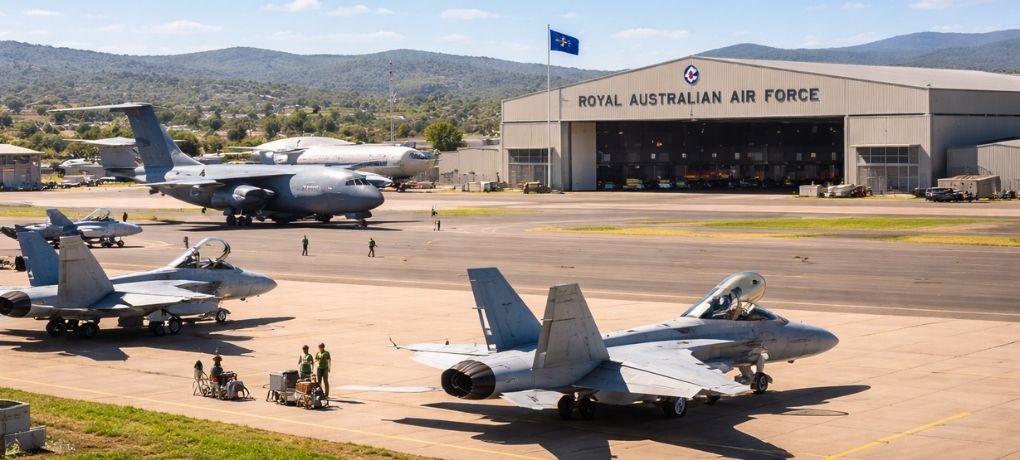
RAAF Base Amberley is the largest operational air base in the Australian Defence Force and a critical hub for Australia’s air combat capability. Established in 1940 and located around 40 kilometres south-west of Brisbane, it supports frontline readiness by providing a live operational environment for pilots, aircrew, and air traffic controllers to maintain currency, proficiency, and training across multiple aircraft types.
Within the base, the Engine Test Cell 1 (ETC1) facility plays a specialist role in testing aircraft jet engines, supported by a dedicated Defence Fuel Installation that enables safe and continuous engine testing operations.
By Steve Spindler
Drafter
Feb 2024
Credit: The image has been generated by AI and depicts a conceptual RAAF base. It is not an actual site.
Queensland, Australia
Region
Apollo Property
Client
2023
Completion Date
Not Available
Project Value
Client Background
Apollo Property is an established Australian construction business experienced in delivering projects for the Department of Defence. At RAAF Base Amberley, Apollo acted as Principle Contractor for works to the Engine Test Cell and associated fuel installation, a project that demanded exacting documentation standards given the safety-critical nature of jet engine testing operations and the strict Metadata and formatting requirements that apply to all Defence facility records.
Apollo engaged Dewick & Associates to produce and coordinate the multi-discipline documentation package, drawing on our experience in delivering Building Handover Manuals in the Defence Format.
The Challenge
RAAF Base Amberley’s Engine Test Cell 1 (ETC1) and its associated Defence Fuel Installation sit within one of the most technically demanding environments on any air base. The facility brings together high-pressure hydraulic systems, specialist fuel handling infrastructure, purpose-built HVAC designed for jet engine testing conditions, fire protection systems engineered around significant fuel-related risk, and integrated electrical and ICT networks that support both testing operations and broader base security.
What makes this particularly complex is not just the range of services, but the level of interdependence between them. Each system must perform reliably in a high-risk operational setting where safety, precision, and continuity of service are critical.
Capturing this accurately in Building Handover Manuals, and ensuring it aligns with the strict Defence documentation framework, requires more than standard technical reporting. It demands a detailed understanding of how these systems operate in practice, alongside the ability to structure information with the correct metadata so it can be seamlessly integrated into Defence asset management systems.
How We Solved It
Dewick & Associates delivered the full multi-discipline manual set covering Architectural, HVAC, Electrical, ICT, Hydraulic and Fire services, all structured in the required Defence Format. Working closely with Apollo’s delivery team and subcontractors, we coordinated the collation of manufacturer data, commissioning records, certificates, warranties and installation documentation to ensure every system was fully evidenced and traceable.
A key focus was alignment with the Australian Department of Defence documentation and asset requirements, including compliance with the Defence Estate Quality Management System (DEQMS) framework Defence Estate Quality Management System. Our in-house drafting team also produced As-Installed Drawings with the required metadata structure to support Defence asset registration, reducing the risk of downstream corrections and ensuring the package was ready for direct system upload.
By managing the full documentation scope in-house, Dewick provided Apollo with a single point of accountability, keeping delivery aligned with programme milestones and reducing coordination risk across multiple trades.
The Result
The project was successfully closed out with a complete, Defence-compliant handover package for works at RAAF Base Amberley’s Engine Test Cell 1 and Defence Fuel Installation. The Department of Defence now holds a fully coordinated set of discipline-specific Operation and Maintenance Manuals supported by As-Installed Drawings and structured metadata, all aligned to Defence requirements and the DEQMS framework.
The documentation provides the base facilities team with accurate, auditable records to support safe operation and maintenance of critical systems, including those governed by high-risk fuel handling and safety controls consistent with Australian WHS legislation Safe Work Australia WHS Laws.
For Apollo, the deliverable ensured final project close-out to Defence standards at one of Australia’s most strategically significant air bases, with all documentation structured for long-term asset management and operational readiness.
Sources & References
The content in this case study has been informed by project documentation and client communication provided to Dewick & Associates during and following the completion of the project. Where external sources have contributed to our understanding of relevant standards or industry practice, these are listed below.
The image has been generated by AI and depicts a conceptual RAAF base. It is not an actual site.
Note: Some content in this case study draws on a combination of sources rather than direct quotation. Where this is the case, contributing sources are acknowledged above rather than cited inline.
Defence – As Constructed Drawings
Provision of Defence standard record drawings produced using AutoCAD and provided with titles and numbers following the requirements of the Spatial Data Management Plan (SDMP).
Defence – Meta Data
Converting standard construction documents into searchable, compliant digital assets specifically formatted for upload to the National Spatial Information Management System (NSIMS), inline with International Standard (ISO 19115).
Skilled drafting team use the Department of Defence Metadata Entry Tool (MET) app to categorise documents based on their content, relevant discipline and information provision;
Defence – O&M Manuals
Authoring of Defence Estate Quality Management Systems (DEQMS) format Building or Site Infrastructure O&M Manuals for the efficient operation, effective maintenance, decommissioning and final demolition of a building or structure. The documents are technically authored to detail each assets as detailed on the project’s GDL, recording the following:
Asset ECID and project EBI
Maintenance details
Associated Literature
DO YOU NEED CONSTRUCTION Documentation FOR YOUR NEXT PROJECT?
Outsource to our expert team so you can stay focused on delivering high-quality on-site construction